
Limited-Time Offer
Buy 4 Windows, Get 1 Free
Window Replacement in Columbia, MO
Custom replacement windows, professional installation, and long-term support from Windows USA in Columbia, MO
Schedule a FREE In-Home Consultation
This site is protected by reCAPTCHA and the Google Privacy Policy (opens in a new tab) and Terms of Service (opens in a new tab) apply.
or call (800) 272-2085
 Rated 4.7
  4.7Rated 4.7
 A+ratingA+rating
 certifiedEnergy Starcertified
A Growing City With Two Different Window Problems
Columbia has been adding people and houses for decades, and it has done it without demolishing much of what was already here. The result, from a window standpoint, is a city running two housing stocks side by side. Drive the older grid around the university and the mid-century blocks that spread out from it, and you are looking at homes whose windows are somewhere between fifty and a hundred years old, or whose replacements went in during an era of aluminum and thin glass. Drive to the edge of town and you are looking at subdivisions finished within the last twenty-five years, whose windows are neither old nor, in a lot of cases, good.
Those two houses call for the same product for completely opposite reasons, and the mistake is treating them as one market. The older house has a fit problem: openings that have moved and materials that have failed. The newer house has a specification problem: openings that are perfectly square and units that were chosen on cost. Both end up at a custom-built window, but the conversation that gets them there is different, and it is worth understanding which one you are having before anyone quotes you.
What Mid-Century Windows Are Doing Now
The post-war neighborhoods here were built with windows that made sense at the time and do not now. Wood sash, often single-glazed, hung in openings that have been absorbing and releasing moisture through seventy Missouri summers. Aluminum frames, popular through the sixties and seventies, that conduct outdoor temperature straight to the interior surface. Storm windows added later as a workaround, which is exactly what they are — a second layer bolted on because the first one was not doing the job.
What those windows are doing today is fairly predictable. The wood ones have swelled, shrunk, and been painted over enough times that half of them will not open and the other half will not stay shut without a stick. The aluminum ones sweat every cold morning, because the frame is colder than the room and the moisture in the air collects on it, and the water has been running down onto the sill for long enough to have taken the paint and sometimes the wood beneath it. Neither type is holding much conditioned air, and both have been drawing on the furnace and the air conditioner for decades without anyone assigning them the blame.
Multi-chambered vinyl fixes the mechanism rather than adding another layer. It absorbs no moisture, so it does not swell, bind, rot, or corrode, and it holds its dimensions across the full annual range. The chambers inside the profile trap air, so heat crossing the frame works through sealed pockets instead of running along a conductive path — which keeps the interior surface warm enough that condensation largely stops forming. And because the window is built to the opening rather than the opening adjusted to the window, a seventy-year-old frame that has settled out of square gets a unit that matches it instead of a stock size packed in with foam.
What the Newer Subdivisions Got Instead
Homeowners in the newer parts of Columbia and out toward Ashland are usually surprised to be having this conversation at all. The house is not old. Nothing is rotting. And yet certain rooms never match the thermostat, a pane or two has gone permanently cloudy, and the bills do not look like the bills of a modern house.
The explanation is almost always the same. Windows are one of the easiest places to reduce cost in a spec build, and a builder-grade unit can carry the same category name as a serious one while being a materially different product — thinner extrusions, fewer chambers, cheaper glass, and an insulated unit whose edge seal was never built to last the life of the house. The tell is fogging between the panes, which is not dirt and cannot be cleaned. It means the edge seal has failed, the argon has escaped, and outside air is circulating inside the assembly. That unit has not degraded; it has finished. Our own insulated units are built around Intercept® Ultra spacers specifically because that edge is where insulated glass fails first, and holding it airtight through years of expansion and contraction is the whole job.
Newer houses also tend to carry more glass than older ones — larger openings, wider spans, sometimes a whole wall of them facing whichever way the lot happened to face. That is pleasant in April and expensive in July, and it makes the glass package the decision that matters most in these homes.
Rentals That Became Family Homes Again
Columbia has a housing pattern that most cities its size do not, and it shows up plainly in the windows. Neighborhoods near campus spent years as student rentals, and rental economics do not reward capital improvements that a tenant will never notice on a lease. Roofs get done because they have to be. Furnaces get done because they fail loudly. Windows get painted, caulked, weatherstripped, and left.
As those blocks have turned back toward owner occupancy — young families buying into walkable older neighborhoods — the new owners inherit forty years of that deferral all at once. It is usually the first winter that makes the case. The rooms nearest the glass never warm up, the sills sweat, one bedroom is unusable, and the gas bill for a modest house reads like a much larger one. None of that is mysterious. It is the accumulated result of a house whose envelope was maintained to a rental standard rather than a residence standard.
Replacing every opening at once is what resets it, and it is also the moment when doing it properly pays for itself twice: once through the bills, and once through what a fully re-windowed house is worth on a street where several of its neighbors have not done the work yet.
Mid-Missouri's Full Continental Swing
Columbia sits far enough inland that nothing moderates its weather. Summers are hot and humid; winters bring genuine cold, snow, and the freezing rain that periodically works its way across the middle of the state. Spring and fall are short and volatile enough to put thirty degrees between one day and the next. Regional climate records are published by the National Weather Service (opens in a new tab), and what they describe is a place where the furnace and the air conditioner both work hard rather than one carrying the year.
That has a consequence people underrate: it is a mechanical problem as much as a thermal one. Every material in a window expands through summer and contracts through winter, and a seal that only holds at one end of that range is not a seal. It is why a house can feel tight in May and drafty in January without anything visibly changing. Interlocking sashes meet as one continuous seal at the rail rather than two surfaces resting against each other, engineered spacers hold the glass unit airtight across the cycle, and vinyl moves little enough to begin with that the fit on installation day is the fit years later.
Orientation, Solar Heat, and the Light You Cannot See
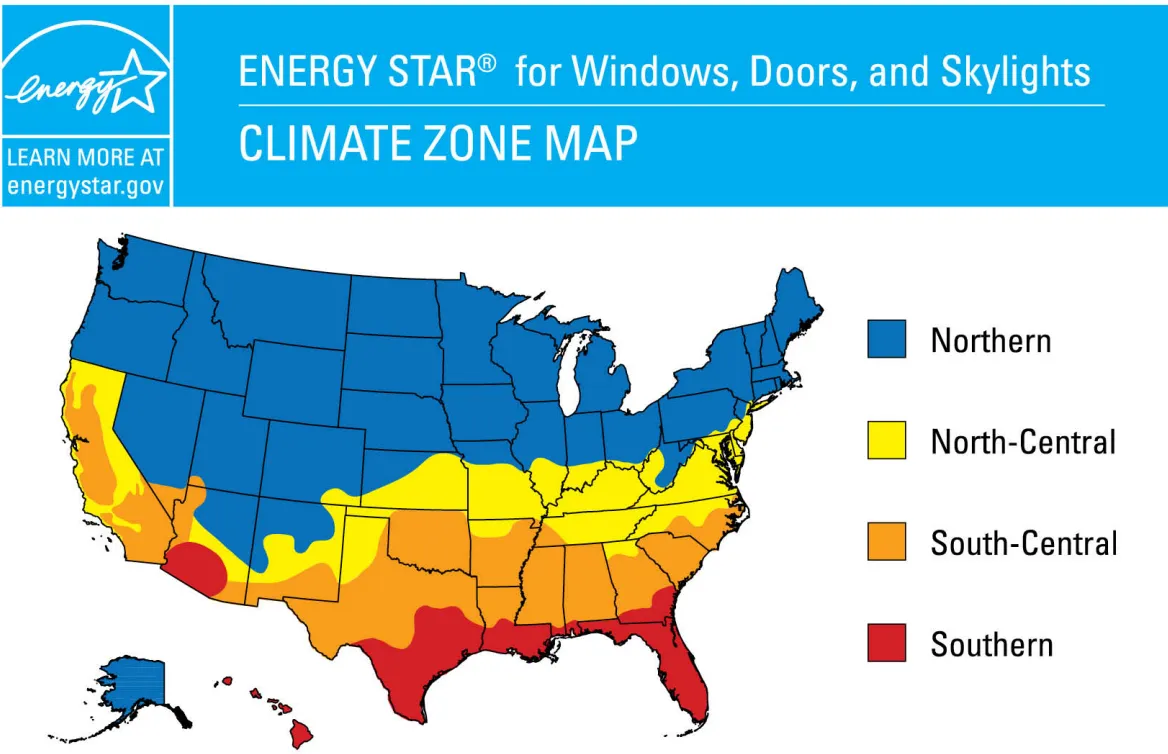
Not every opening in your house has the same job, and in a climate that runs both directions the same house can want different answers on different walls. A north-facing window is nearly all insulation problem. A west-facing one takes the full afternoon and is mostly a solar-control problem. In newer Columbia subdivisions, where the largest glass areas were placed by the lot rather than by the sun, that distinction is worth working through before settling on a glass package. The U.S. Department of Energy (opens in a new tab) sets the logic out as a specification grid:
[Consumer Guide to Energy-Efficient Windows (opens in a new tab)]
The glass is where that specification lives. Cardinal Low-E 366 (opens in a new tab) carries a triple-layer coating that rejects solar heat and turns it back outward rather than tinting the view — a real distinction, because tinted glass buys solar control by taking your daylight. The coated approach keeps the room bright and takes the heat out of the light, and it insulates well enough that the inside face of the glass stays warm on a cold morning, which is the half of the job a summer-only product ignores.
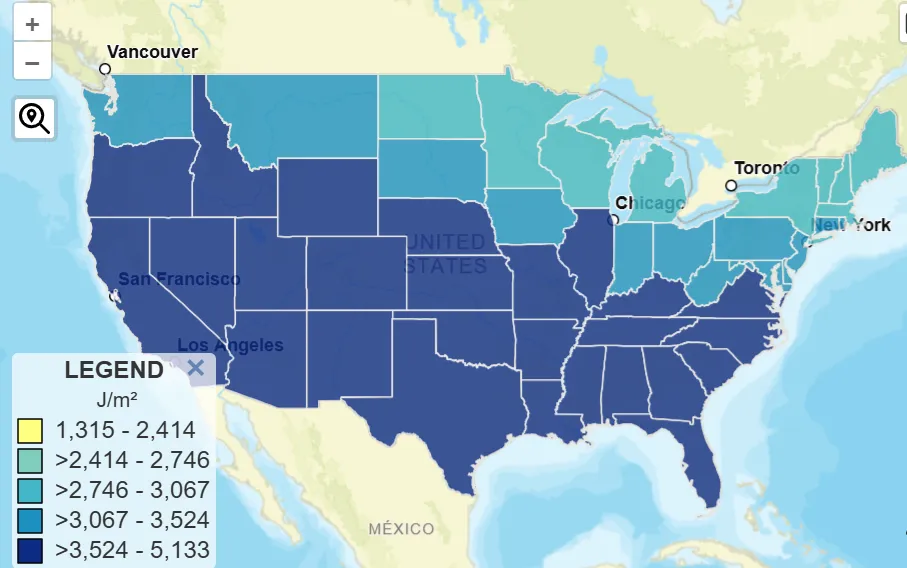
The coating does one more job that has nothing to do with temperature. The CDC (opens in a new tab) tracks an Average Daily Dose of Ultraviolet (UV) light (opens in a new tab) across the continental states, and ultraviolet is the component of sunlight that works on a house continuously and invisibly. It reaches the people in the room first — the International Ultraviolet Association (opens in a new tab) notes that ordinary glass is essentially transparent to UVA, which the Skin Cancer Foundation (opens in a new tab) identifies as a main cause of premature skin aging. It bleaches what is in the room next, steadily fading furniture, fabrics, flooring, and artwork & photos (opens in a new tab). And it works on the window itself: ultraviolet wavelengths penetrate solid materials (opens in a new tab), and unprotected vinyl suffers mechanical, physical and chemical degradation from solar radiation (opens in a new tab) that shows up as cracking and chalking (opens in a new tab), color change, and strength lost beneath the surface.
Our glass screens out 95% of that ultraviolet, and the vinyl carries a UV inhibitor through the material rather than as a coating on the surface, so the frame does not chalk, fade, flake, or peel on whichever elevation of your house takes the afternoon.
ENERGY STAR Certified Options, Working Both Halves of the Year
Efficiency claims usually assume heat is moving one way. Columbia does not oblige. A house here pays a real heating bill and a real cooling bill inside the same twelve months, so an envelope improvement either works in both directions or it is half of one.
ENERGY STAR certified options are available across our line, pairing Cardinal Low-E 366 glass and argon fill with multi-chambered vinyl frames — an assembly that slows heat leaving the house in January and rejects solar heat pushing in through a July afternoon. ENERGY STAR states the result plainly: “Replacing old windows with ENERGY STAR certified windows lowers household energy bills by an average of up to 13 percent nationwide when replacing single-pane windows. Lower energy consumption also reduces greenhouse gas emissions from power plants and homes.”
Custom-Built in Arkansas, Installed Across Mid-Missouri
Whichever of Columbia's two housing generations your house belongs to, the answer is a window built for the opening instead of an opening adjusted to the window. Every unit we install is manufactured at our plant in Hot Springs, Arkansas, to the measurements our representative takes at your house, then fitted by professional installation crews. The company that built the window is the company that stands behind it afterward. Installation crews work Columbia along with Jefferson City, Ashland, Boonville, and Fulton.
What replacement actually changes, in either kind of house:
- A single pane in a wood or aluminum frame is close to no insulation at all, and the utility bill has been covering that shortfall in both seasons for years.
- Rooms nearest the glass stop lagging the thermostat, which is the change homeowners notice first and the one that makes a room usable again.
- Condensation staining sills and feeding mildew stops once the interior glass surface stays warm through a cold morning.
- Fogged, seal-failed units are replaced with insulated glass built around spacers designed to hold that edge airtight.
- Vinyl frames need no painting, do not rot, and do not corrode, so the maintenance line goes to zero.
- Modern locking hardware closes an entry point that worn original sash tends to leave easy.
On price, the shape of the company matters as much as the product. Most window quotes carry an importer's margin, then a distributor's, then a dealer's, stacked one on the next before anyone measures your wall. Windows USA manufactures, sells, and installs, so that arithmetic is shorter, and the transferable lifetime limited warranty behind the finished job comes from the same company that built the product. Nearly 60 years in business and more than 200,000 homeowners are what stand behind it. The estimate is free, it happens at your house, and it ends with one written number.
Our Products
Windows and Sliding Patio Doors
Windows and doors, each custom-built to fit your home.
Double-Hung Windows
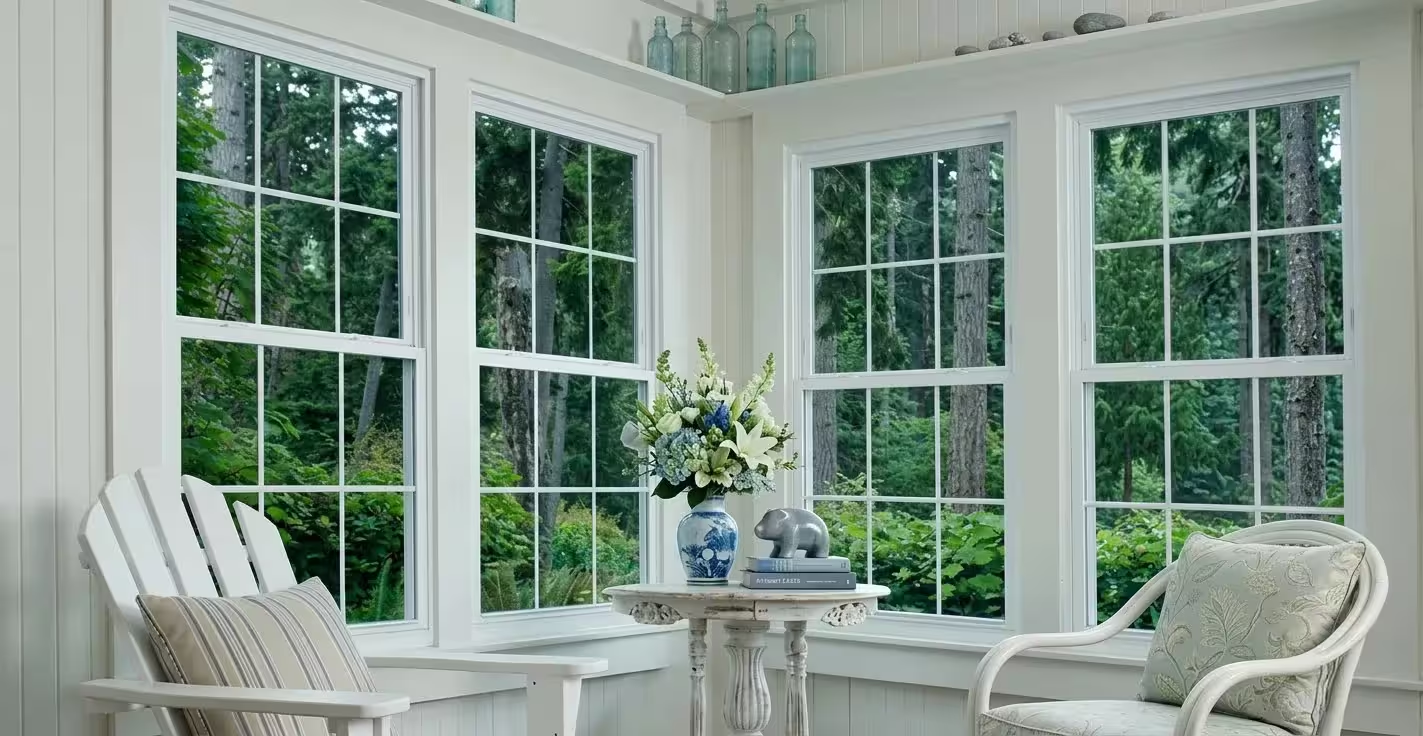
The most popular window in America for a reason. Double-hung windows are easy to use, easy to clean, and built to keep your home comfortable year-round, without running up your energy bill.
Learn more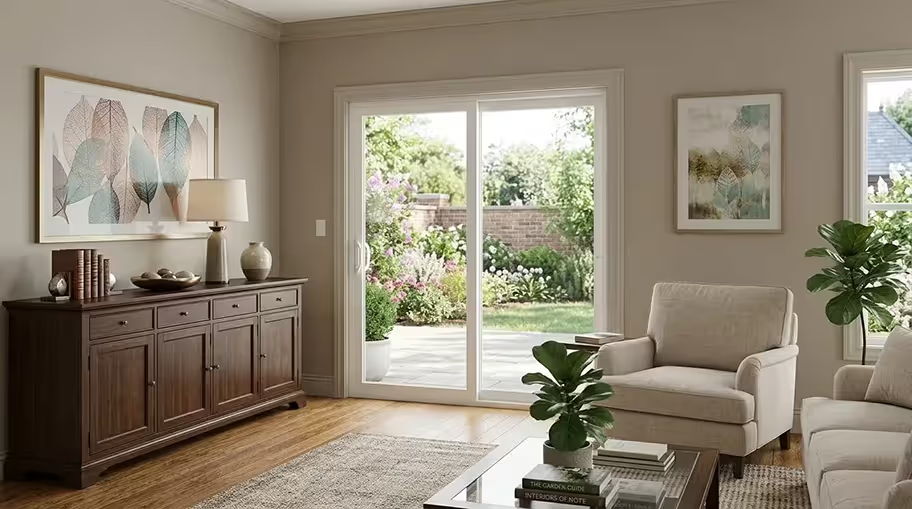
Sliding Patio Doors
Transform the feel of any room. Our sliding patio doors bring in more natural light, open up your space, and glide smoothly for years without sticking, warping, or drafting.
Learn more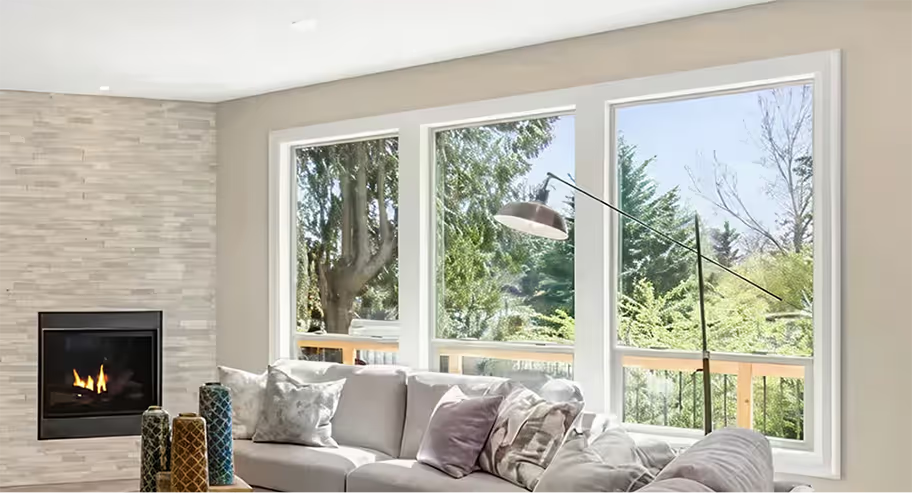
Casement & Awning Windows
Perfect for hard-to-reach spots and rooms that need better airflow. These windows seal tighter than almost any other style, keeping outside air, noise, and moisture where they belong – outside.
Learn moreNot Sure Which Windows Are Right for You?
Why Windows USA
Why Homeowners in Columbia, MO Choose Windows USA
Windows USA designs, builds, and installs every window we sell, all backed by a lifetime limited warranty.
Why Windows USA
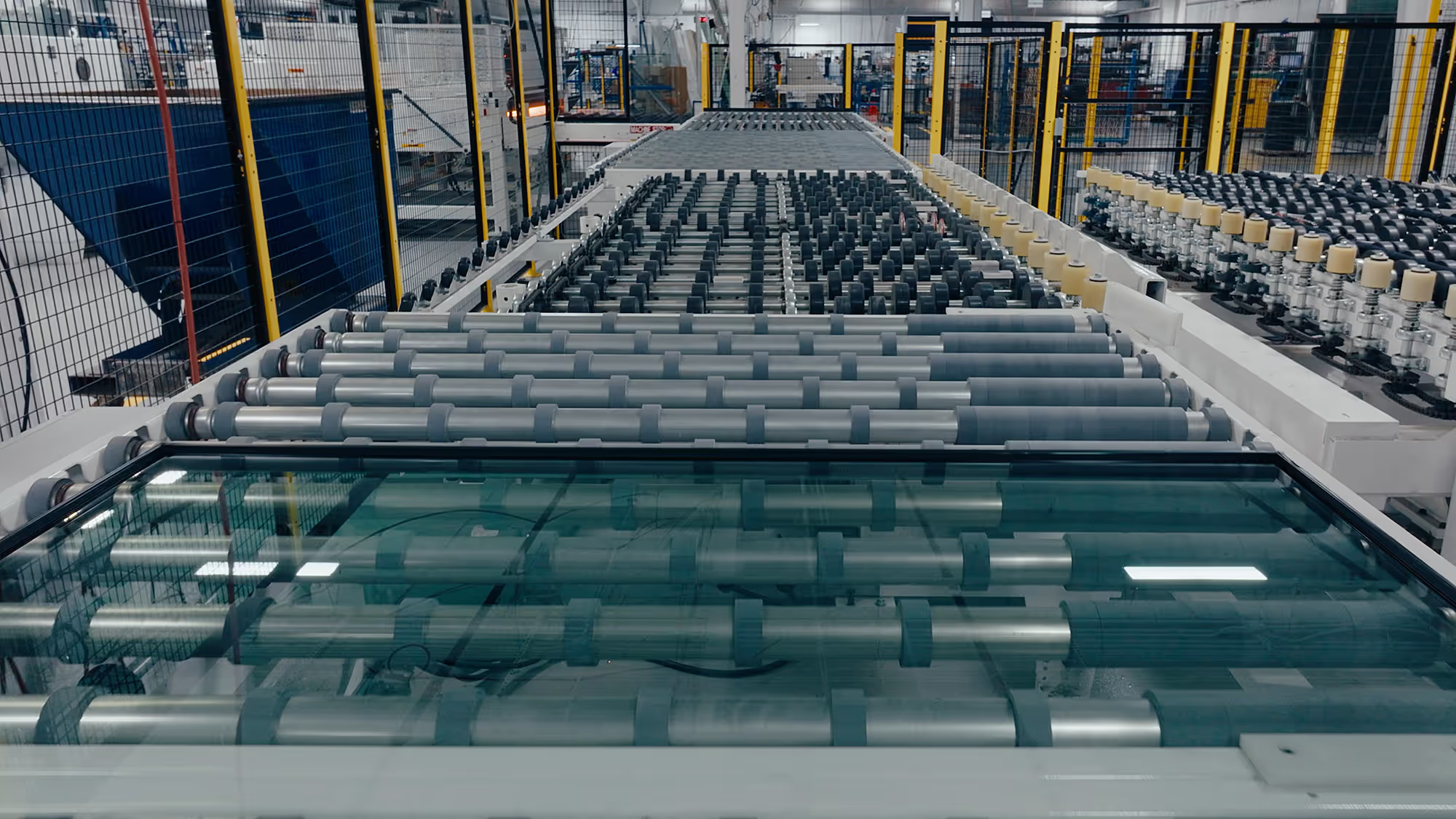
We design and build our windows in our own factory right here in America, and professional installation crews install them.
- Nearly 60 years of window manufacturing and installation experience
- Design, manufacturing, installation, and support from one company
- One company responsible - from consultation to lifetime limited warranty
- Windows built for regional climate and energy needs
Benefits
Benefits of Our Windows for Homes in Columbia, MO
New windows do more than look good. Here's how they make a real difference in your home.

Lower energy bills with ENERGY STAR®–rated options

Improved indoor comfort year-round

Reduced outside noise

Increased home value and curb appeal

Durable vinyl frames built to last
3 Step Process
Our Simple Window Replacement Process
From first visit to finished install, we make it easy.
1. Free In-Home Estimate
We come to your home, measure properly, answer questions, and provide a window replacement estimate.

2. Custom Manufacturing
Your windows are built to fit your home exactly, using energy-efficient vinyl materials.

3. Professional Installation
Professional installers complete the job efficiently and respectfully, leaving your home clean and comfortable.

Comparing quotes from other companies? .
See the Difference
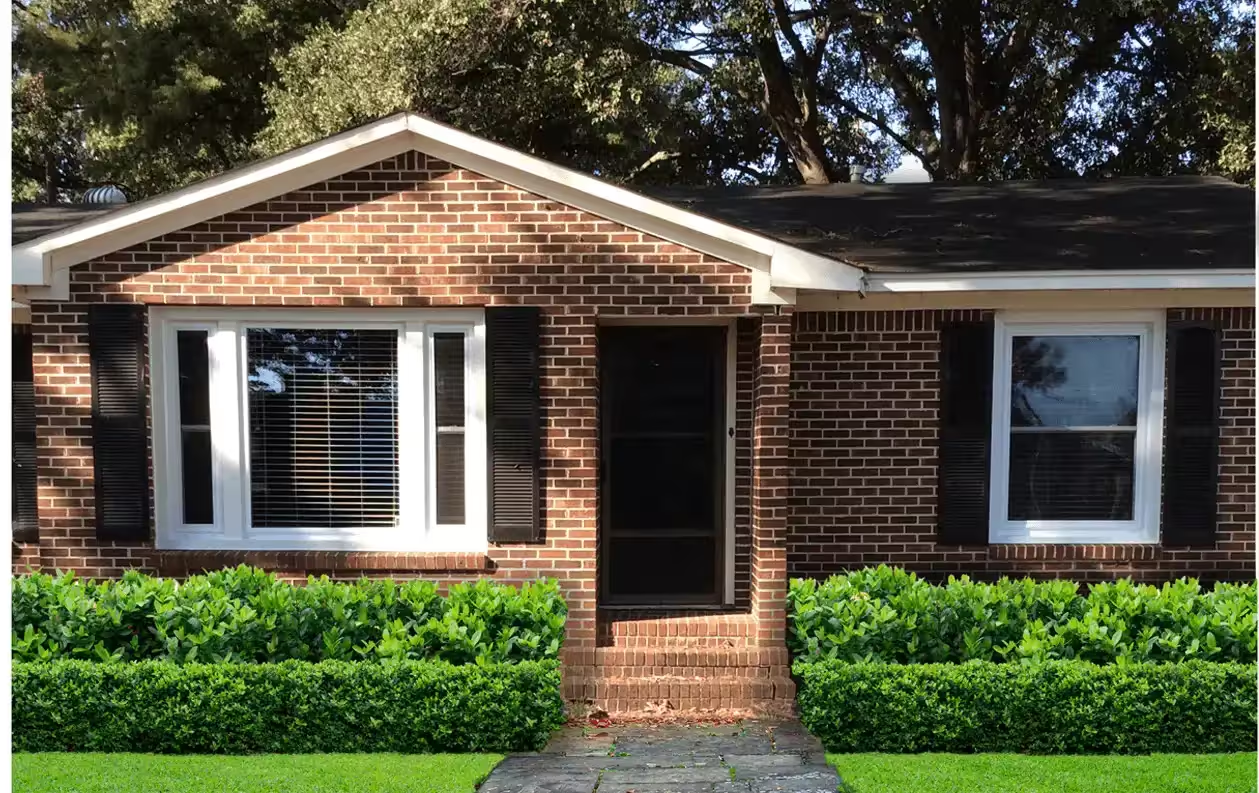
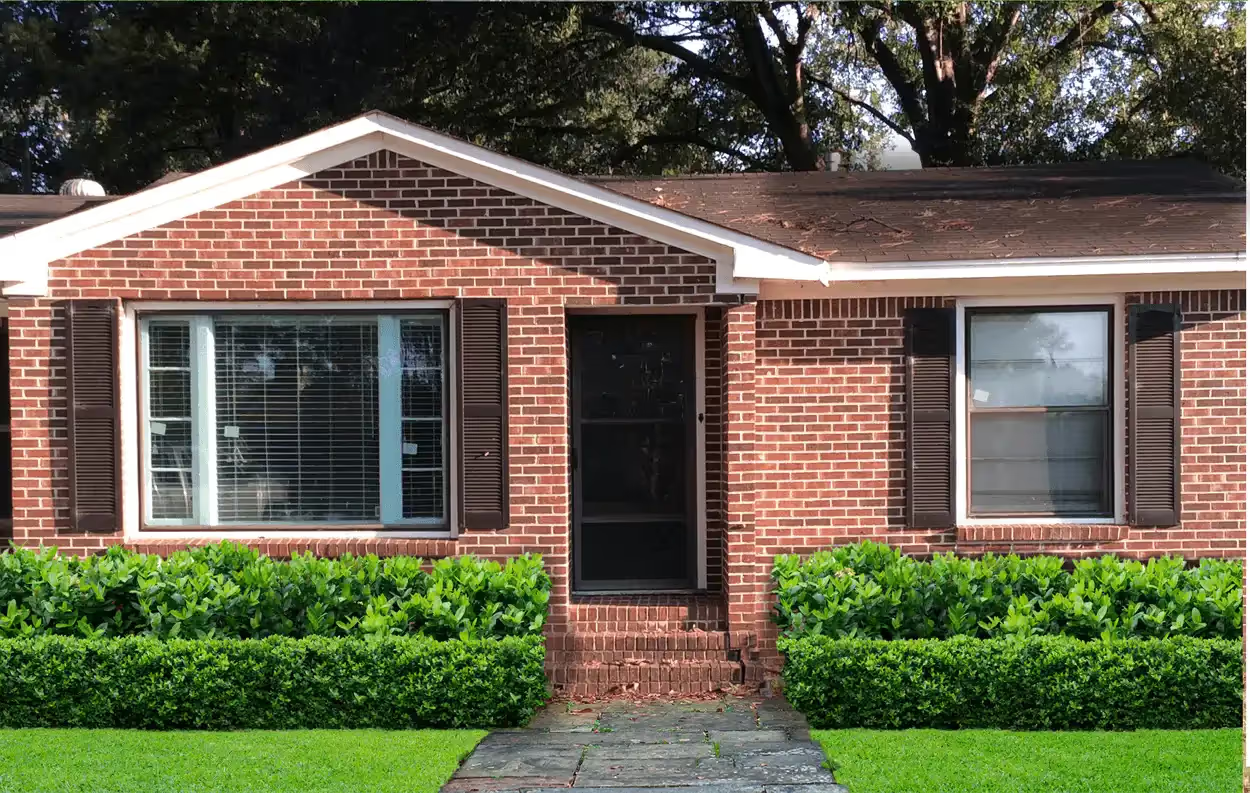
Before and After Window Replacements
See how replacement windows transform the look of a home.
Local FAQ
Window Replacement Questions in Columbia, MO
The number comes from your house rather than from a price list. Opening count and opening size set the baseline, operating styles and glass package move it, and what sits behind the old trim can move it again. In Columbia that last factor swings hard, because a 1958 ranch off Broadway and a 2019 build on the edge of town hide very different conditions. We do not price sight unseen. A consultant measures every opening during a free in-home estimate and leaves one written figure for the finished job. Windows USA builds its own product and sells factory-direct, so no importer, distributor, or dealer margin is folded into it.
Ones that perform in both directions, because Columbia asks for heating and cooling in the same year. Multi-chambered virgin-vinyl frames and sashes trap air inside the profile so heat cannot run straight through it, and vinyl neither swells in July humidity nor conducts January cold the way the aluminum frames on so many mid-century houses here do. Cardinal Low-E 366 (opens in a new tab) glass rejects solar heat in summer while still insulating in winter, argon fill slows transfer through the cavity, and interlocking sashes with Intercept® Ultra spacers keep the whole assembly sealed through the annual swing. Our windows page has the full build.
Usually, and the saving lands in two separate seasons rather than one. ENERGY STAR reports that replacing single-pane windows with certified units lowers household energy bills by an average of up to 13 percent nationwide. Mid-Missouri runs the furnace hard in winter and the air conditioner hard in summer, so ENERGY STAR certified options are earning their keep across most of the calendar. The steepest improvements show up in houses still on original single panes, and in newer homes whose builder-grade units have already lost their seals.
A consultant visits, measures each opening on its own instead of working from standard sizes, and goes through styles, glass, and hardware with you. Nothing comes off a shelf, so there is a build period while your windows are manufactured to those exact measurements at our Arkansas plant. Professional installation crews then remove the old units, fit the new ones, seal, and clean up, usually inside a single visit, and the work carries a transferable lifetime limited warranty. Our process page covers every stage.
Installation crews cover Columbia and mid-Missouri around it, including Jefferson City, Ashland, Boonville, and Fulton, and the footprint runs on well past this part of the state across the rest of Missouri. The locations page shows where else we work. Towns that are not listed are still worth a phone call — smaller communities between our markets usually sit within reach of a crew already working nearby.
Customer Reviews
What Our Customers Are Saying?
4.7 from 2,222 reviews
★★★★★
From start to finish this was a good experience. Professional unbelievable installation and clean up. Highly recommend.
Google review
★★★★★
Excellent service, condition excellent, professionalism outstanding
Google review
★★★★★
Our old faded window are gone. Replaced with amazing beautiful windows. Installed and cleaned. I didn't lift a finger. Wow. Just wow. So happy to have great windows. Windows USA did everything they said they would. Highly recommend
Google review
★★★★★
From the start to the finish, everything was done with precision, from covering all inside to clean up. Everything was put back in the place it came from. Travis and Andrew answered all my questions and was very professional. Best ever.
Google review
★★★★★
Installation of my windows went smoothly. The windows look great and I am now experiencing quietude inside of my home because of these new windows.
Google review
★★★★★
Presentation, installation, and looks are all professional. Highly recommend if looking for quality windows for your home. Very pleased with the crew that came to install.
Google review
Areas We Serve Around Columbia, MO
- Columbia
- Jefferson City
- Ashland
- Boonville
- Fulton
Also serving Missouri in Springfield, MO , Joplin , Branson , Cape Girardeau — or view all locations .
A Comfortable Home Starts with the Right Windows
American Made. Factory Direct. Expert Installation.